Artificial intelligence will not take your job; someone who uses it will, entrepreneur John Hope Bryant said during a Fireside Chat Wednesday, Feb. 18.
“Your job is not going to be destroyed by AI,” Bryant said. “Your job is going to be taken by somebody who uses AI.”
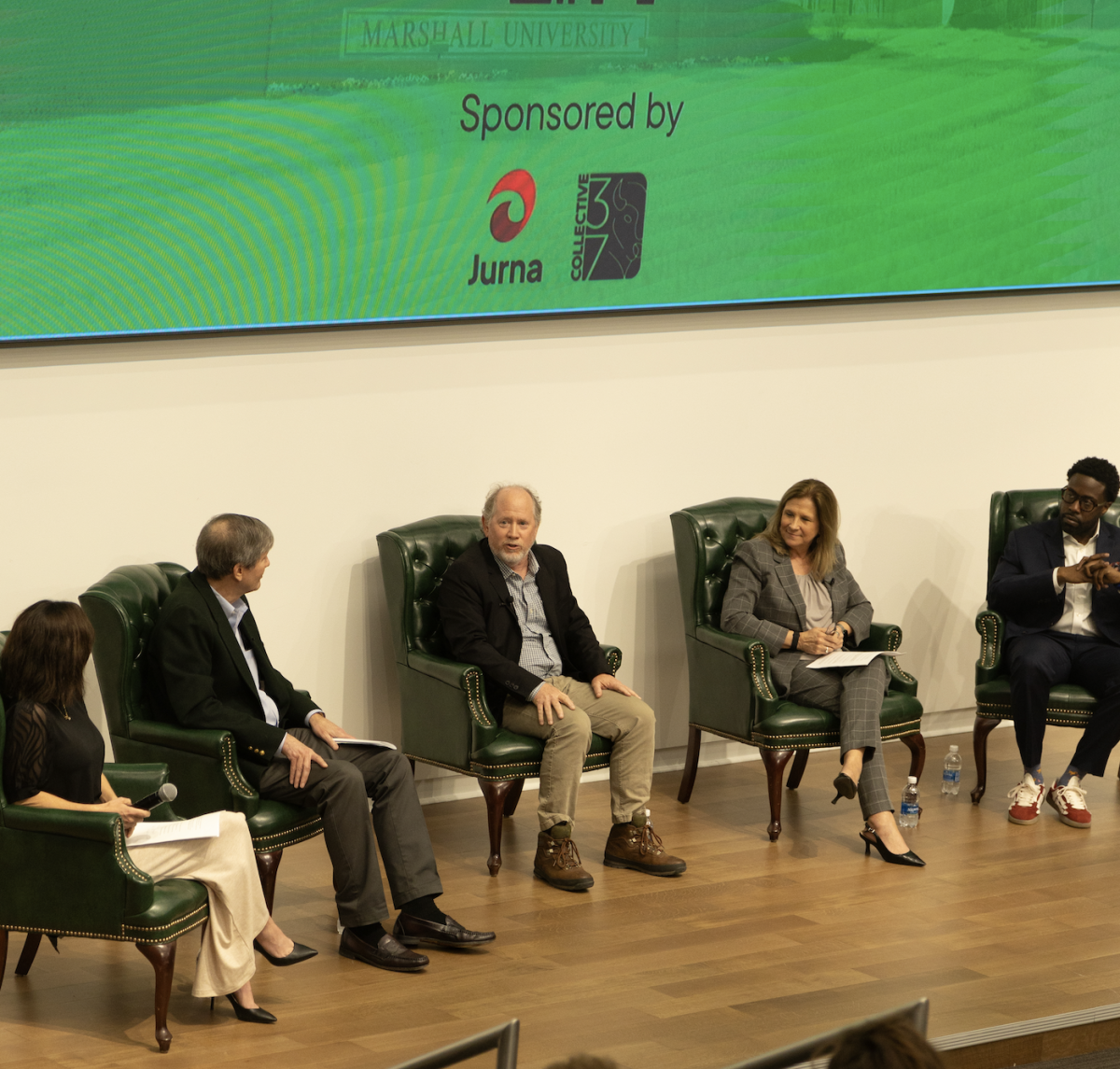
Bryant, the founder and CEO of Operation HOPE, joined Marshall University President Brad D. Smith at the Joan C. Edwards Performing Arts Center as part of the university’s centennial observance of Black History Month. The conversation focused on artificial intelligence, financial literacy and expanding economic opportunities across generations.
Bryant said students must develop both financial literacy and what he called “AI literacy” to remain competitive in a rapidly changing workforce.
“Financial literacy is the Civil Rights issue of this generation,” Bryant said.
He said artificial intelligence will reshape industries, arguing workers who adapt and integrate the technology will create new opportunities.
“We don’t react to the future,” Bryant said. “We respond to it.”
Throughout the evening, Bryant tied technological change to his upbringing. He said he grew up in South Central Los Angeles, where financial instability shaped his early life. His father, struggled with financial literacy despite entrepreneurial ambition.
“The more money he made, the more broke we got,” Bryant said.
Bryant said witnessing financial stress and instability led him to pursue business education at a young age. At nine years old, a banker visiting his classroom introduced him to the idea of entrepreneurship.
“I asked him how he got rich legally,” he said.
Bryant said he began looking up business terms in the dictionary and then launched small ventures, including selling candy he purchased at wholesale cost. At age 10, he was earning hundreds of dollars per week.
“I was done,” Bryant said. “Cooked. Baked.”
Bryant said early failures were equally formative. He said he experienced homelessness at 18 after a series of unsuccessful ventures and poor financial management.
“I was a great hustler,” Bryant said. “I wasn’t a great manager.”
He said those experiences reinforced the importance of financial education, budgeting and credit literacy, lessons he now teaches through Operation HOPE.
The organization works with banks and corporate partners to provide financial coaching, credit counseling and entrepreneurship training. Bryant said Operation HOPE places financial literacy counselors inside bank branches to help individuals improve credit scores, reduce debt and build savings before applying for loans.
Bryant also emphasized youth engagement, saying exposure to financial literacy early can change long-term economic outcomes. He said introducing students to credit education, entrepreneurship and economic systems builds confidence and long-term stability.
Smith said the discussion reflects Marshall’s responsibility to prepare students for emerging industries while preserving core human skills.
“Our responsibility is to make sure our students are ready,” Smith said.
Smith said critical thinking, communication and collaboration remain essential even as artificial intelligence expands.
“There are some things technology can do extraordinarily well,” Smith said, “but humanity still matters.”
Among those attending were middle and high school students from the Fairfield community brought by mentors from Fairfield U, a program affiliated with Marshall’s medical school that introduces youth to STEM and professional career pathways.
Fourth-year medical students Clay Willis and Kara Piechowski attended alongside the youth participants.
Willis, a lifelong resident of Ironton, Ohio, said the program is designed to broaden students’ horizons by introducing them to career possibilities they may not have previously imagined.
“Our leadership decided to bring the kids here tonight to hear what Mr. Bryant had to say,” Willis said. “Hearing about his nonprofit, Operation HOPE, was incredible. It really gives an example of how corporate America can invest back into the people and allow pathways for growth for the richest and the poorest in the country.”
Piechowski, from Flatwoods, West Virginia, said exposing students to conversations about financial literacy and emerging technology aligns with the program’s mission.
“We were super excited to bring our kids,” Piechowski said. “It was just really awesome for the state as a whole.”
Piechowski said Bryant’s comments about embracing artificial intelligence resonated in health care, where the technology is already influencing diagnostics and data analysis.
“Artificial intelligence is really on the horizon and already here,” Piechowski said. “It was interesting to hear him say, ‘Get on board; the future is now.’”
Piechowski said medicine is already exploring how artificial intelligence can assist with diagnostics and data analysis, but Bryant’s message emphasized preparation rather than fear.
“I think we can really learn a lesson from that as future physicians,” Piechowski said.
Willis said Bryant’s emphasis on maintaining human connection stood out.
“There’s all this fear of AI replacing jobs and those human connections,” Willis said, “but Bryant offers an alternative future where we don’t just react to the loss of jobs; we respond to it and find ways to integrate the human connection while accepting the future.”
Bryant said artificial intelligence could reduce startup costs and expand access to entrepreneurship by automating administrative functions and lowering barriers to entry. Communities that embrace change early will be better positioned for economic growth.
“America is not a country,” Bryant said. “She’s an idea.”
Bryant said the coming years will require preparation from individuals, institutions and communities alike.
“The future is coming whether we like it or not,” Bryant said. “The question is whether we’re ready for it.”
Willis said the message extended beyond artificial intelligence, especially for the middle and high school students who attended.
“We can be a positive part of this change or be left in the dust,” Willis said.
David Lozano can be contacted at [email protected]