

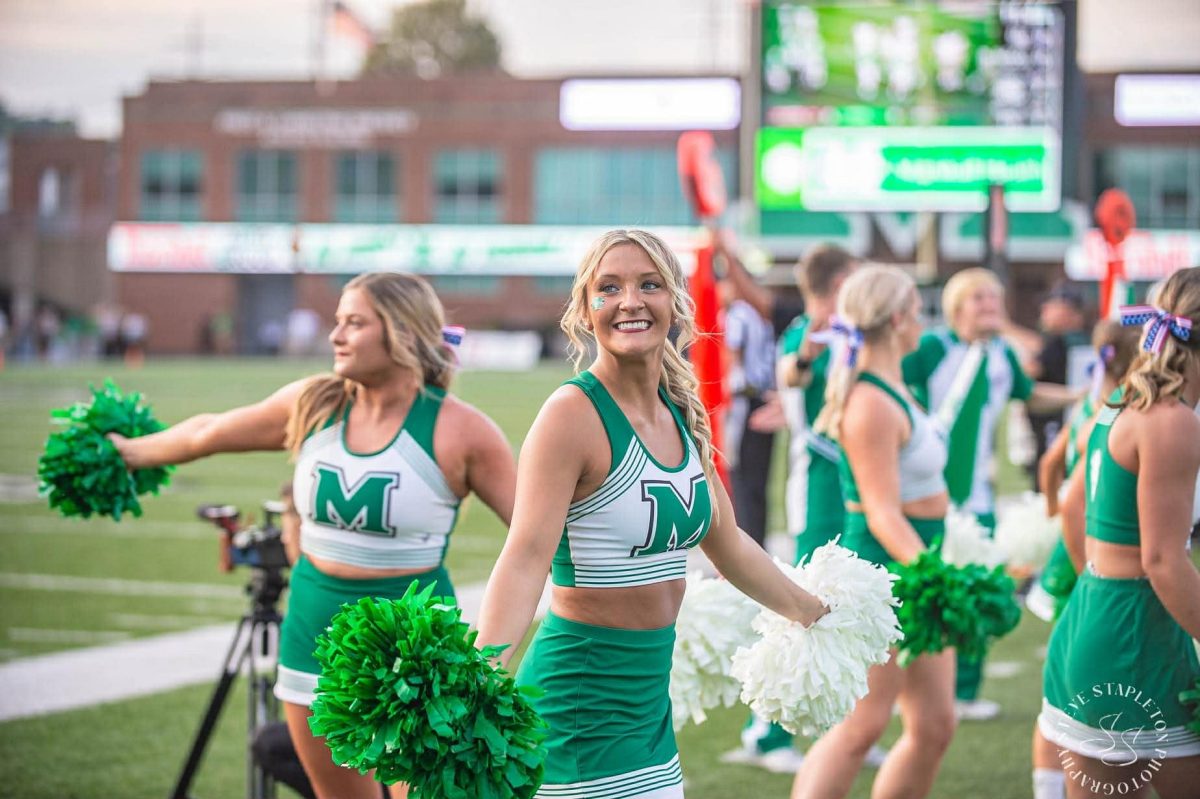
While Marshall says adding STUNT aims to expand opportunities for female student-athletes, some say the university should be directing its efforts toward existing programs instead.
Following the announcement to reinstate Women’s Swimming & Diving at the Board of Governors meeting March 18, current student-athletes and alumni celebrated the swim team’s success. However, the decision to move forward with STUNT was met with criticism from others.
“It was very frustrating,” Marshall Cheer alumna Leah Huffman said. “I was very mad – so mad, I made a Facebook post, and I never make those.”
Huffman, who cheered for the university from 2020 to 2025, took to Facebook after Marshall initially announced it would be replacing the swim team with a competitive stunt team.
“It is difficult to understand the decision to add a STUNT program when Marshall already has athletes on the cheer team who are highly skilled in stunting,” she said in the Feb. 17 post. “Expanding a new program while existing talent remains underfunded raises valid concerns about consistency in investment.”
STUNT, according to the sport’s official website, “removes the crowd-leading element and focuses on the technical and athletic components of cheer, including partner stunts, pyramids, basket tosses, group jumps and tumbling.”
Although USA Cheer created STUNT as a sport, Athletic Director Gerald Harrison said STUNT and cheerleading are “separate activities with different competitive structures.” At this point, he said, it is unclear whether student-athletes currently participating on other teams, like cheer, also may participate in the STUNT program.
“There may be opportunities for crossover depending on scheduling and NCAA considerations, but those decisions will ultimately be made in coordination with coaching staffs and compliance to ensure we are supporting student-athletes appropriately,” Harrison said.
As for the program’s fiscal aspects, costs for STUNT are estimated to be $330,000, according to a Feb. 17 announcement from University President Brad Smith.
GENERAL FUNDING
Having experienced the cheer team’s struggles with funding first-hand, Huffman said Marshall Cheer might greatly benefit from the money going toward STUNT.
The team’s uniforms, she said, have been in use since the early 2000s. Their shoes, shirts and practice gear were paid for out of pocket, by the coaches or through fundraising.
Marshall Dance alumna Hannah Shell, a 2019-2022 student-athlete who remains in contact with current student-athletes, echoed similar statements about the dance team.
“I can’t even tell you the last time the dance team has gotten new uniforms,” Shell said. “I know for sure there’s a uniform that has lipstick stains on it, and I know good and well that one of those girls has to wear that every year because if there’s no other size, that’s what they have to wear.”
With a roster that allows for up to 65 student-athletes, scholarships within the STUNT program will be determined based on “overall financial structure and Title IX framework,” Harrison said, which does not guarantee a scholarship to all 65 members.
Because the cheer and dance teams do not receive full athletic scholarships, many participants face difficulties balancing responsibilities as a full-time student, athlete and employee, Huffman said.
“Other athletes don’t have to work because they’re getting this extra money to live, while cheerleaders are praying we get by another week,” she said.
COACHING
While the university will soon begin its search for a STUNT coach, both Huffman and Shell said coaching was a consistent issue for their respective teams, with Huffman comparing the position to a “revolving door.”
Although Huffman said she appreciated all of her coaches throughout her time on the team, she said the university did not support her team in their requests to learn from highly qualified coaches.
Meanwhile, Shell said she may not have ever had the chance to join Marshall Dance if not for Anna Marsh, who, as a senior, unofficially assumed the head coaching position when the university could not fill the role.
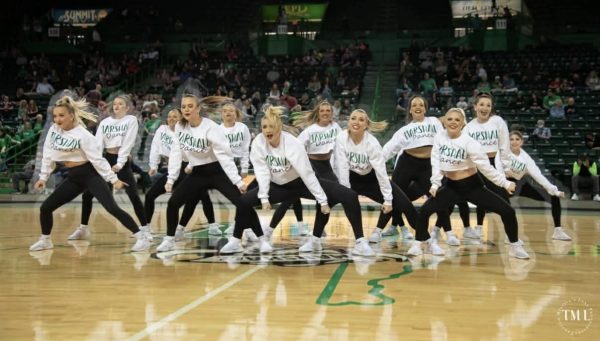
“I believe strongly that she’s the whole reason this program still exists,” Shell said. “Because they weren’t going to have [a coach] at all unless something else happened my freshman year.”
Without funding for choreographers, Shell said it was also not uncommon for the student-athletes to choreograph their own halftime routines when she was on the team.
COMPETITIONS
Harrison said timelines for STUNT recruitment and tryouts will begin once a head coach is selected. The program is expected to compete in the Spring 2027 NCAA Championship.
Although the dance team does not currently have the funding to attend competitions, Shell said she believes the program should have equal opportunities to other college dance teams. Additionally, she said adding the competitive aspect could grow the program’s attraction and retention.
Cheer, however, attends one competition each year, the National Cheerleaders Association College Nationals, which Huffman said is the highlight of the year for many cheerleaders.
Prior to the competition, the student-athletes are responsible for funding their trip to NCA cheer camp, where participating teams receive bids that could partially or fully fund their trips to nationals.
The year before she joined, Huffman said the team received a bid and continued to fundraise but could not attend nationals due to COVID.
“There was one cheerleader who asked where the money went, and they said the money just went where it was needed,” Huffman said.
Because neither he nor the current cheer coach, Kenyatta Grant, was on staff at the time this incident occurred, Harrison said “it would not be responsible for [them] to speculate on the specific use of those funds.”
UNCERTAINTY AHEAD
As for the future of the programs, Huffman said it is disheartening to think about the cheer team losing members to STUNT.
“If numbers go down, that wouldn’t really be good in the case of trying to get our cheer program at least recognized in some sort,” Huffman said.
As a cheer alumna, she said the worst possible outcome would be losing the momentum of “every single person before [her] who has fought for this program.”
Shell, however, is confident that both programs will remain strong throughout this transition.
“I don’t think, between cheer and dance, they’re going to let that happen,” the dance alumna said. “The girls themselves are very passionate about their programs, and they will fight for what they want to keep.”
Baylee Parsons can be contacted at [email protected].


