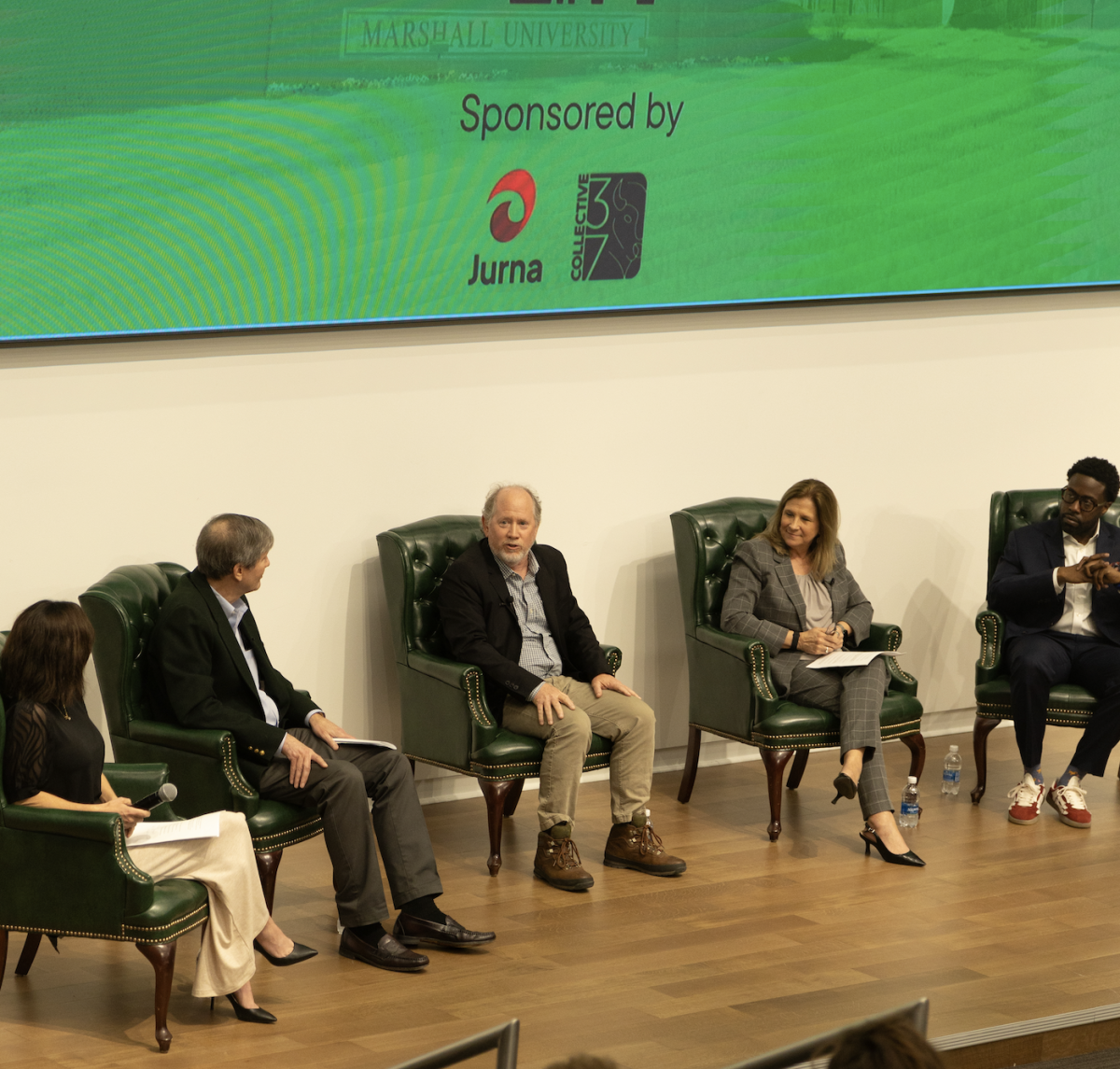
The English Department gathered in Corbly with apt attention and support for readings from their colleagues as two associate professors shared excerpts of their works during Lunchtime Faculty Readings Friday, Feb. 27.
Robert Ellison, associate professor of English, began the event, presenting his chapter of “We are Appalachia!,” a collection of essays, stories and poems written by members of the Marshall community. Ellison’s chapter, titled “Wandering Between Two Worlds: From One Appalachia to Another,” focuses on his own experience as both a newcomer and long-term resident of the region.
“The previous title for this was, ‘A Texas Transplant Story,’ and I think that might kind of sum it up,” Ellison said.
Ellison is a native of Texas but now considers himself a seasoned Appalachian and West Virginian after spending many years in the state. His story chronicles his dual-state journey through various anecdotes and personal insights into Huntington, Appalachian and Texan culture with an extra side of religious and faith-driven growth.
Despite his personal sense of belonging, though, Ellison points out not everyone sees him in the same adopted light. He mentions the darker, less inclusive side of the state that often holds fast to natives while pushing away outsiders.
“If they want to see how their neighbors are talking about the Appalachian experience, that would be a go to book for me,” Ellison said on the importance of his chapter and the anthology.
Following Ellison, Benjamin Williams, associate professor of English, presented his own piece, “The Stench of the Border Patrol,” which was an excerpt from his broader project, “The Carcera Border.” His excerpt was an investigation of the border crisis through the lens of the rise in popularity of former border patrol memoirs.
Williams peeled back the layers of historical propaganda and racism feeding the government agency and furthered his investigation to the future, where modern measures are continuing to define the inhumane practices of the border patrol.
“When people talk about immigrant enforcement and the brutality that’s being waged against people of all kinds of legal status, it’s often we need to take issue with ICE. ICE is only 20 years old,” Williams said, “but what I think I’m offering by looking at this longer history is how so much of this has seeped into the very fabric of our nation in a way that’s really hard to decouple that violence from the work they are doing.”
As a work in progress, Williams felt the event was beneficial for the advancement of his work through praise and critiques of his fellow faculty.
“This piece is part of a book project, but it’s also an essay that’s currently on review, so I’m going to get comments from others and feedback from others, and so it just helps with curating it down more,” Williams said.
For both Ellison and Williams, the theme of inclusion and exclusion was pertinent. Their works, while focusing on vastly different topics, held an important thread relating to belonging and the risks associated with its lack or loss.
Claire Johnson can be contacted at [email protected]